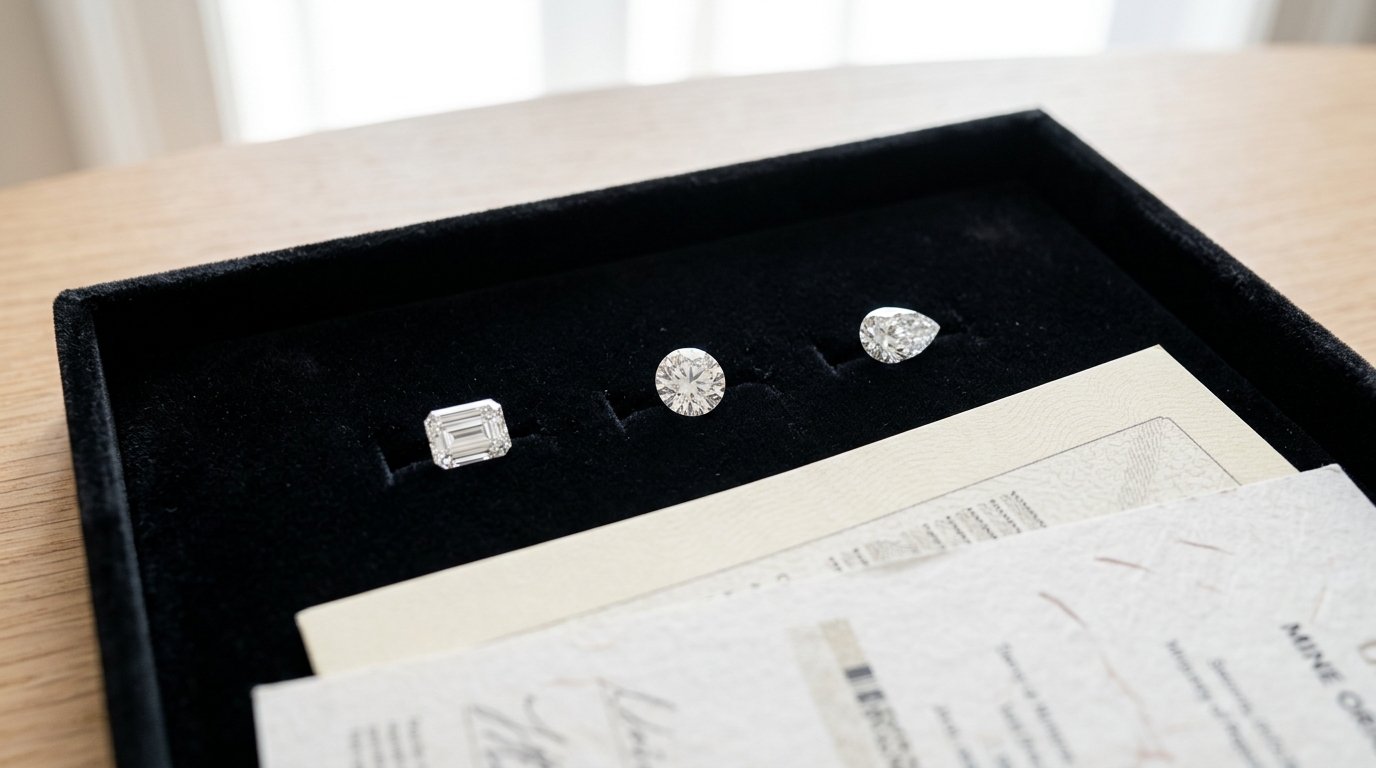
An ethically sourced diamond carries verified documentation proving it was mined without funding armed conflict, without child labor, and under safe working conditions - and you can confirm this before you buy through certification schemes, retailer transparency, and direct questions about the stone's origin.
The diamond industry has changed significantly over the past two decades. The Kimberley Process Certification Scheme (KPCS), established in 2003, created the first international framework to stop "blood diamonds" from entering the legitimate market. But the Kimberley Process alone is not a complete guarantee of ethical sourcing - it only addresses conflict financing, not labor rights, environmental impact, or community benefit. Knowing how to read beyond a single certificate gives you real confidence in your purchase.
Step 1: Ask for the Kimberley Process Certificate - Then Ask What Else They Have
Any reputable diamond retailer should be able to provide documentation showing their stones are Kimberley Process compliant. The KPCS requires rough diamonds to be traded in tamper-proof containers with government-issued certificates. If a retailer cannot produce this documentation, walk away.
However, treat the Kimberley Process as the floor, not the ceiling. Critics - including Global Witness, the NGO that co-founded the scheme - have publicly noted that the KPCS definition of "conflict diamond" is narrow. A diamond from a mine with documented human rights abuses can still technically be KPCS compliant if those abuses don't involve a recognized rebel faction.
Look for retailers who go further. The Responsible Jewellery Council (RJC) certification covers human rights, labor practices, environmental impact, and business ethics across the full supply chain. As of 2026, RJC membership requires third-party audits every three years. An RJC-certified retailer is a meaningfully stronger signal than a Kimberley Process certificate alone.
Step 2: Trace the Country of Origin
Not all diamond-producing countries carry the same ethical risk profile. Knowing where your diamond was mined matters.
- Botswana- Home to the Jwaneng and Orapa mines, operated through Debswana (a joint venture between De Beers and the Botswana government). Revenue sharing has directly funded national healthcare and education infrastructure. Widely considered a benchmark for ethical mining.
- Canada- Mines like Diavik and Ekati in the Northwest Territories operate under strict Canadian environmental and labor law. Canadian diamonds are traceable and often carry the CanadaMark certification from Dominion Diamond Mines.
- Namibia- Namdeb Holdings (another De Beers government partnership) operates with strong environmental controls and community investment programs.
- Zimbabwe (Marange region)- Has a documented history of serious human rights abuses at the mines. Proceed with caution and demand specific provenance documentation for any diamond from this region.
- Central African Republic and certain DRC regions- Ongoing conflict and weak governance make ethical sourcing verification extremely difficult.
Ask your retailer to name the mine, not just the country. Single-mine traceable diamonds - where the stone can be tracked from ground to setting - are the gold standard for provenance.
Step 3: Look for Independent Grading and Traceability Certifications
A grading report from the Gemological Institute of America (GIA) or the International Gemological Institute (IGI) tells you about a diamond's quality (cut, color, clarity, carat). It does not tell you about its ethical provenance. These are different things, and conflating them is a common consumer mistake.
For provenance specifically, look for these programs:
- CanadaMark- Tracks Canadian-origin diamonds with a unique inscription number on the girdle of the stone, verifiable at the point of sale.
- GIA Diamond Origin Reports- GIA issues origin reports for certain stones that have maintained an unbroken chain of custody from mine to grading lab. These are not routine for every stone but are available for specific programs.
- De Beers Tracr platform- A blockchain-based registry that assigns each diamond a digital record from mine to retail. Retailers using Tracr can show customers a verified digital journey for the stone.
- Everledger- Another blockchain provenance platform used by multiple retailers to register and verify diamond origin and characteristics.
Step 4: Consider Lab-Grown Diamonds as an Alternative
Lab-grown diamonds are physically, chemically, and optically identical to mined diamonds. They are not simulants - they are real diamonds created in controlled environments using High Pressure High Temperature (HPHT) or Chemical Vapor Deposition (CVD) processes.
From an ethical sourcing standpoint, lab-grown diamonds eliminate the mining supply chain entirely. There are no conflict concerns, no artisanal mining labor risks, and no land disruption in vulnerable ecosystems. They are graded by the same labs (GIA, IGI) using the same 4Cs criteria.
The tradeoff is energy consumption. CVD and HPHT processes are energy-intensive. Labs powered by renewable energy - a growing number as of 2026 - dramatically reduce the carbon footprint. Ask your retailer which energy source the producing lab uses if environmental impact is your primary concern.
Step 5: Ask Your Retailer Direct Questions
A retailer with a genuinely ethical supply chain will welcome your questions. A retailer who deflects, gives vague answers, or relies solely on "we only use conflict-free diamonds" without supporting documentation is a red flag. That phrase has become so widely used it has lost specific meaning.
Ask these questions directly:
- Can you name the mine or mining company this diamond came from?
- What certifications does your supply chain carry beyond the Kimberley Process?
- Are you an RJC-certified member?
- Do you offer blockchain traceability or independent provenance documentation for this specific stone?
- What is your policy if a stone in your supply chain is later linked to an ethical violation?
A confident, specific answer to each of these is the strongest signal you'll find in-store.
Ethical Sourcing: Mined vs. Lab-Grown vs. Vintage Diamonds
Diamond Type Conflict Risk Labor Risk Environmental Impact Traceability Ethically mined (certified) Low Low to medium Medium to high High (with Tracr/CanadaMark) Uncertified mined Medium to high High High Low Lab-grown None Low Low to medium (energy-dependent) Very high Vintage/antique None (no new mining) None (no new extraction) Very low Low to medium (historical records)Vintage and antique diamonds - stones from the Victorian, Edwardian, or Art Deco eras - are an often-overlooked ethical option. No new mining is required. The stone already exists. The main limitation is that historical provenance documentation is rarely available, and the original mining conditions cannot be verified.
Red Flags to Watch For
- A retailer who only says "conflict-free" without naming certifying bodies
- No documentation available beyond a GIA grading report
- Inability to name the country of origin, let alone the mine
- Prices dramatically below market rate with no explanation (cheap price + murky sourcing is a consistent pattern with ethically compromised stones)
- Pressure to decide quickly with no time to review documents
The Bottom Line
Verifying that a diamond is ethically sourced takes three things: documentation beyond the Kimberley Process, a retailer who can name specific mines and certification bodies, and willingness to consider alternatives like lab-grown or vintage stones if the paper trail runs cold. The most confident ethical purchase is one where you can trace the stone's journey and the retailer answers every question without hesitation.
Is the Kimberley Process enough to guarantee an ethical diamond?
No. The Kimberley Process only certifies that a diamond did not fund a recognized rebel conflict. It does not cover labor rights, environmental damage, or community impact. Look for additional certifications like Responsible Jewellery Council membership, CanadaMark, or blockchain traceability through De Beers Tracr or Everledger.
Are lab-grown diamonds truly ethical?
Lab-grown diamonds eliminate mining-related conflict and labor risks entirely. The main ethical consideration is energy use during production. Labs powered by renewable energy produce lab-grown diamonds with a substantially lower environmental footprint than mined alternatives. They are a genuinely strong ethical choice for most buyers.
What is the most traceable type of mined diamond?
Canadian diamonds with CanadaMark certification are among the most traceable mined diamonds available. Each stone carries a laser-inscribed unique ID number on the girdle, verifiable through a registry. GIA Diamond Origin Reports and De Beers Tracr blockchain documentation offer similarly high traceability for stones enrolled in those programs.
Can I trust a retailer who says their diamonds are "conflict-free"?
The phrase "conflict-free" has become so broadly used that it carries limited meaning on its own. Treat it as a starting point, then ask for the specific certifications, named mining regions, and supply chain documentation that back up that claim. A retailer who cannot go beyond the phrase deserves more scrutiny.
Are vintage diamonds a good ethical alternative to newly mined stones?
Yes - vintage and antique diamonds require no new mining and carry no current conflict or labor risk. The tradeoff is limited historical documentation about original mining conditions, which makes full provenance verification impossible. For buyers whose primary concern is avoiding new environmental or social harm, vintage diamonds are an excellent option.